Krathos
Outer Sector — Uncharted · Classification Level 9 · Ancient Technology — Kratarian Species
Planet Profile
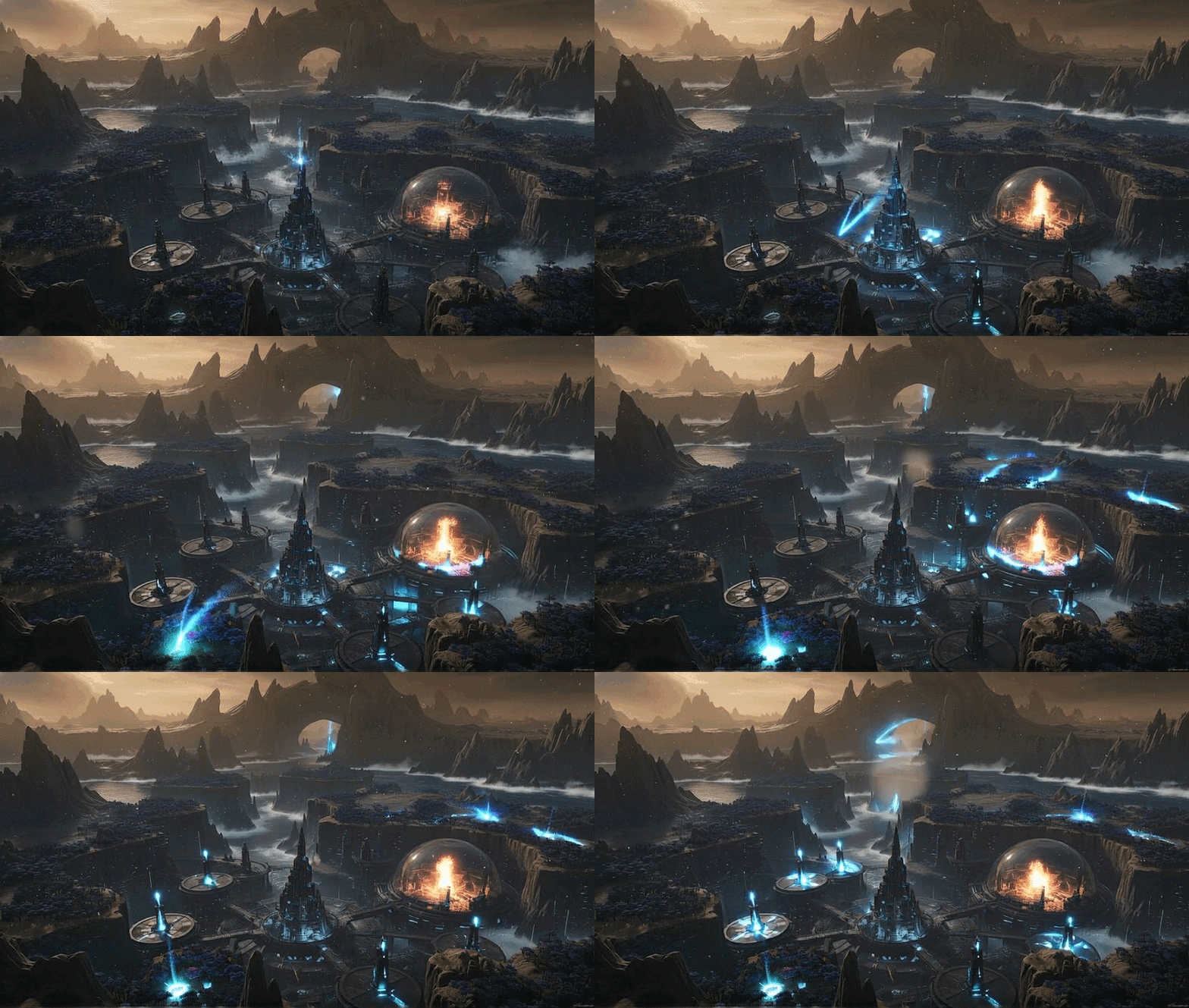
Krathos is a world of extreme geological character — forbidding to any visitor arriving from outside, and entirely navigable to those born within it. Above ground, the landscape is uncompromising: sheer rock faces rising kilometres into a dense amber atmosphere, canyon systems deep enough to contain their own weather, sparse coastal zones where dark seas press directly against stone cliffs without beaches or transition. Forests grow low and dense in sheltered canyon floors. The surface is hostile the way all truly old things are hostile — not aggressive, simply indifferent to whether you are equipped to be there. For the Kratarians, the surface is the exterior of a house. Dangerous to strangers. Familiar to those who grew up reading it.
The Nucleus — City of the Ancients' Foundation
The only permanent settlement on Krathos is the Nucleus — a city of considerable scale built directly upon the technological foundations left by the Ancients, the civilisation that preceded the Kratarians by an estimated forty thousand years. The Ancients vanished without documented cause, leaving behind structures of a precision and scale that Kratarian engineering cannot fully replicate even today. What they left functions. Energy systems still active. Structural frameworks still intact. Processing architectures still running processes whose purpose has not been entirely decoded. The Kratarians have built their civilisation on top of something they did not make and do not entirely understand — and have derived from it resources, knowledge and power sufficient to make the rest of the planet effectively irrelevant. The Nucleus is not just a city. It is an inheritance that has not finished revealing what it contains.
Biology
The Kratarian species evolved in the demanding conditions of the canyon surface and upper subterranean levels — thin atmosphere with high pressure differentials between elevation zones, rock formations that shift without warning along deep fault lines, and extended periods of reduced solar exposure. The result is a species with exceptional physical resilience, a skeletal structure denser than human baseline, and sensory systems calibrated for reading environmental instability before it manifests. They do not fear unstable ground. They read it. The large cranial horns present in Kratarian females serve dual function — passive seismic resonance detection and social status signalling. Their size and curvature carry significant communicative weight within Kratarian hierarchy.
Distinctive Traits
Pale Nordic complexion adapted for low-light canyon and subterranean environments, long white hair, large curved horns similar in structure to mountain ungulates functioning as seismic sensors and status markers, elongated pointed ears with wide-range directional sensitivity, light grey eyes with exceptional low-light acuity, athletic and physically imposing build, combat-functional semi-rigid armour suit in white and black — covering torso, arms and forearms — with high futuristic boots completing the field configuration.
Culture
Kratarian society is structured around earned authority — rank is not inherited but demonstrated through capability, endurance and the quality of decisions made under pressure. Growing up within the Nucleus, surrounded by technology they use but did not originate, has produced a culture that is simultaneously pragmatic and reverential — deeply aware that their present power rests on a foundation they did not build, and equally aware that what matters is what you do with what you have been given. They are direct to the point of bluntness and do not negotiate positions they consider already settled. Their interest in human subjects is practical and unambiguous: Kratarian fertility rates have declined significantly over two centuries, attributed to prolonged subterranean habitation and reduced genetic variance. The solution they identified is external biological contribution. They did not ask for opinions on this conclusion. They rarely do.
— Specimen on Record —

SPECIMEN: K-001
STATUS: ACTIVE
CLEARANCE: LVL 9
STATUS: ACTIVE
CLEARANCE: LVL 9
THEKLA WEDLAM — KRATHOS SPECIMEN K-001
Designation
Thekla Wedlam
Species
Kratarian — Field Operative, Senior Rank
Height
1.80 m — not including horn projection
Weight
68 kg — dense build, higher than apparent
Planet of Origin
Krathos
Distance from Earth
Classification pending — sector uncharted
Description
A female Krathosi of senior field rank. Her appearance is striking in the precise way that things adapted to difficult environments tend to be — not decorative, but the result of every feature having a function. Pale skin, long white hair, elongated elfin ears that orient toward sound with visible precision. Her horns are the most immediately arresting element: long, white, curved in the pattern of a mountain ungulate, rising from her temples with a weight and presence that changes the spatial geometry of any room she enters. They are not ornament. They are instrument and rank and warning, simultaneously. Her build is athletic and physically imposing — 1.80 metres of structured capability in a white and black semi-rigid suit that covers torso, arms and forearms, with high futuristic boots. She is, by any objective assessment, extraordinarily beautiful. She is also, by any objective assessment, dangerous. She gives the impression of having no particular interest in which of these you notice first.
Note
Thekla Wedlam introduced herself before issuing instructions. This is considered atypical for Krathosi field operatives, who generally dispense with introduction as an efficiency measure. When asked about it, she stated that she preferred subjects to know who was addressing them. She did not elaborate on why. Observers noted that the effect of knowing her name made the subsequent instructions considerably more difficult to dismiss. This may have been the point.